From Hobby to Career: How Independent Artists Built Their Brands
June 24, 2026
10 Simple Ways to Add More Creativity to Your Daily Routine
June 24, 2026
What does it actually take to build a sustainable creative career? We go behind the canvas to explore the daily rituals, studio habits, and disciplined routines of successful artists—from contemporary painters to the old masters.
There’s a persistent myth about the artistic life: that creativity strikes like lightning, that masterpieces emerge from moments of divine inspiration, and that true artists wait patiently for the muse to arrive.
The reality couldn’t be further from the truth.
Behind every great painting, every breakthrough body of work, and every sustainable art career lies something far less romantic but infinitely more powerful: routine. Successful artists don’t wait for inspiration—they show up, day after day, and let the work itself become the source of inspiration.
As one artist puts it: “To be a painter, you have to come to the studio morning after morning, no matter how you woke up, and paint.” This isn’t about lifestyle or position—it’s discipline: “a daily, almost monastic commitment to working, looking, and repeating.”
Let’s go behind the canvas and explore how successful artists structure their days, protect their creative time, and build careers that last.
The Morning Ritual: Claiming the Day Before the World Does
For most successful artists, the day begins long before the rest of the world wakes up. There’s something about the quiet early hours that allows creativity to emerge without pressure or performance.
Leila Bartell, a London-based painter, wakes at 6am—sometimes before the sun. “There is a quiet sense of productivity in the early hours that suits me, nothing performative, just a sharp sense of consciousness.” Her morning ritual sets the tone: meditation, journaling, and a short workout. “I do not scroll,” she emphasizes. “It is a ritual of clearing space, mentally and emotionally, for what is to come.”
Israeli digital artist Aviad Sajevitch takes it even earlier, waking around 5am. “There’s something about those quiet early hours that lets me begin the day calmly and without pressure.” His morning routine includes black coffee, meditation, gratitude practice, and greeting his cats before heading out for a workout. Interestingly, he notes that “physical movement seems to get the creative wheels turning.”
The common thread? Protecting the morning from technology. As one artist explains, “I do not scroll”—a deliberate choice to keep external noise at bay. Another source confirms this pattern: “The habit most commonly shared among artists is a commitment to answering emails first thing in the morning—and then not thinking about them again.”
Takeaway: Your first hour belongs to you. Before you check email, before you scroll social media, before the world starts making demands—create space for yourself. Even 30 minutes without screens can transform how you approach your work.
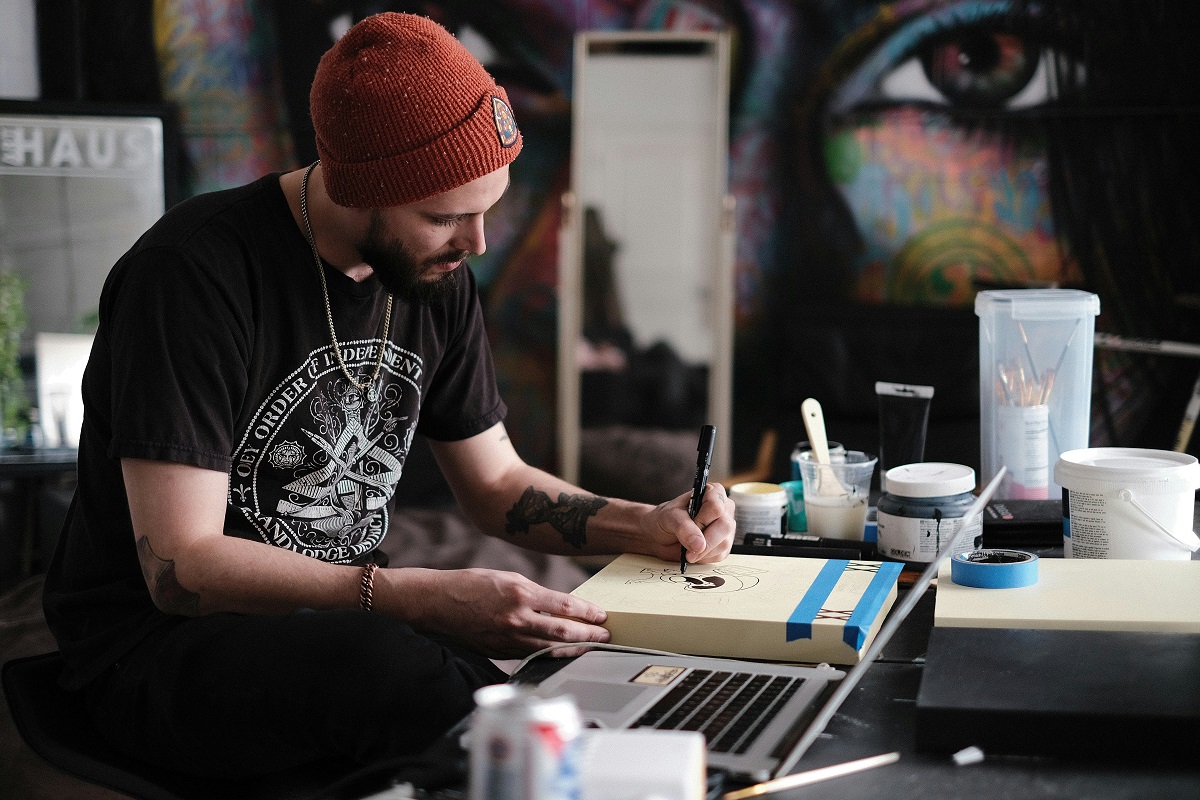
The Studio: Where the Magic Actually Happens
Once the morning ritual is complete, it’s time to enter the studio—the sacred space where ideas become tangible.
For many artists, the transition into creative work is immediate and intentional. Celia Lees, a Toronto-based abstract painter, heads to her studio in the late morning and “once I arrive I try not to sit. I change into painting clothes right away and start working while my energy is highest.”
Nuria Mora, a Spanish artist who moves between street art and gallery work, emphasizes persistence: “My routine is about persistence and discipline. I go to the gym and do push-ups to build my energy every morning, then head to the studio.” She works hard for long hours, pays close attention to her diet, avoids alcohol, and ends her day with meditation.
But the studio isn’t just about painting—it’s about creating an environment that supports the work. Erin Hanson, a professional landscape painter, uses a rolling table with a wooden board taped to the top, giving her “plenty of space to pre-mix all the colors that will appear in the painting.” At the end of the day, she pops the entire palette into a freezer to keep paint fresh—a small organizational habit that saves time and reduces waste.
The environment matters. As artist Frank Eber notes, “Working in a stimulating environment, with excellent lighting, has a huge impact” on creativity and productivity. Your studio doesn’t need to be grand—it needs to be yours.
The Business of Art: Admin, Emails, and the Unsexy Work
Here’s something few people talk about: successful artists spend a significant portion of their day doing administrative work.
Erin Hanson, who runs a multi-million-dollar art business with ten employees, blocks out her mornings for business tasks. “From 9 AM until lunch time, I perform the administrative duties of being an artist,” she explains. This includes coordinating with employees, signing limited edition prints, editing scan images, and updating her website.
Only after lunch does she begin painting—and she paints from 1 PM until 9 PM at night. The demand is constant: “I sell 75% of my paintings before they are dry on the dry racks, so I have a constant pressure to create new works.”
Celia Lees takes a similar approach, handling emails, shipping, and website management when her energy dips later in the day. The key is segmentation: separating creative time from administrative time so neither encroaches on the other.
Takeaway: Block your day into segments. Handle business tasks during your lower-energy hours and protect your creative peak time for the work itself. As Hanson puts it: “It helps to segment my time into ‘painting time’ and ‘administrative time.'”
The Midday Reset: Breaks, Walking, and Recalibration
Even the most disciplined artists understand the value of stepping away.
Leila Bartell keeps lunch simple and often eats alone. “I like solitude, not as retreat, but as alignment,” she explains. “It is a recalibration before the more outward facing part of the day.” If it’s sunny, she walks in Hyde Park, watching the sky—a practice she describes almost as a meditation: “I take photos of clouds almost daily, not to replicate but to remember the feeling of looking up.”
Aviad Sajevitch practices intermittent fasting, finding that “it really enhances my creativity and helps me stay deeply focused on the work itself”. After a short break, he returns to the studio.
These aren’t indulgences—they’re strategic resets that prevent burnout and maintain creative energy over the long haul.
The Afternoon Shift: Meetings, Visitors, and Strategic Thinking
The afternoon often brings a shift in rhythm—from the solitary work of creation to the more outward-facing aspects of an artistic career.
Leila Bartell describes this transition: “From mid-afternoon, the rhythm shifts. Sometimes there is a call with a gallerist, or an artist liaison drops by to film something. Other days it is a studio visit, a curator, a collector, an advisor, the kind of conversations that stretch the work beyond its edges.”
There are also practical days: going over inventory, planning, sketching ideas for future projects, or stepping back “to think strategically about what comes next”. Occasionally, she slips out to a lecture or visits another artist’s studio—“small things that keep the mind lit from other angles”.
Takeaway: Your creative work doesn’t exist in a vacuum. Build time into your week for the conversations, connections, and strategic thinking that sustain a career.
The Evening Wind-Down: Processing What Painting Cannot
How an artist ends their day is just as important as how they begin it.
Leila Bartell’s evenings are quiet: she cooks, reads, or watches a film. Lately, she’s been writing more—“not with an exact objective, but as a form of therapy. It’s cathartic: a way of processing what painting cannot.” She reads slowly—about 20 pages before bed—letting the words linger.
Nuria Mora ends her day with meditation, bookending her mornings with intentional stillness.
This evening practice isn’t about productivity—it’s about integration. It’s the space where the day’s work settles, where new ideas germinate, and where the artist remains connected to their practice even when they’re not in the studio.
Lessons from the Masters: Picasso, Van Gogh, and the History of Creative Discipline
The routines of contemporary artists echo patterns we see throughout art history. Successful artists have always understood the power of structure—even when that structure looked unconventional.
Pablo Picasso famously arrived at his Paris studio around 2pm and painted until about 2am daily, breaking only for a quick dinner. His studio was deliberately messy—not careless, but a specific, intentional order. “He believed the mix of items, sketches, and paintings helped his creativity. Chaos sparked his ideas.”
Vincent van Gogh’s rituals balanced chaos with productivity. His reliance on routine gave structure to his emotional struggles. Coffee and simple food sustained his energy, while letters to his brother Theo provided reflection. He painted for hours without pause and often worked under candlelight.
Salvador Dalí practiced what he called “slumber with a key”—a micro-nap technique where he’d fall asleep holding a key over a metal plate, waking himself up just as he entered the dream state, then immediately sketching what he saw.
Frida Kahlo’s rituals were shaped by physical pain, yet she transformed suffering into creativity. Coffee grounded her mornings, while art became therapy.
What these historical examples reveal is that there is no single “right” routine. Picasso worked nights; Van Gogh worked obsessively; Dalí used naps as a creative tool. What they shared was consistency—a commitment to showing up, day after day, and doing the work.
Building Your Own Creative Routine: Practical Principles
So how do you build a routine that works for you? Here are principles drawn from successful artists across generations:
1. Start Small and Stay Consistent
“The most effective habit I have is to paint for a minimum of 25 minutes every single day,” shares artist Kristy Gordon. “Twenty-five minutes is such a short time that I can never say ‘I don’t have the time.'” Artist Gina Sian adds: “I’ve learned to appreciate small acts done daily over big acts done rarely. Once the habit is formed, it becomes second nature.”
2. Protect Your Creative Time
“Keep that painting time sacred. No excuses,” advises Frank Eber. “If you leave your painting for the time after you’ve done everything else, you’ll never get to it.”
3. Find Your Natural Rhythm
Observe the time of day when you have the most energy and the fewest distractions, and commit to a standing date with your practice. Some artists are morning painters; others work best at night. Honor your own biology.
4. Create a Physical Anchor
“Every great ritual starts with one small, reliable act,” notes one artist. “It doesn’t have to be profound—it just has to happen every day… The anchor isn’t about what you do, it’s about what it signals. It tells your brain, ‘This is the moment we start.'”
5. Separate Creative and Administrative Time
Segment your day into creative blocks and business blocks. Don’t let emails interrupt your flow. Don’t let admin work consume your peak creative hours.
6. Integrate Art into Daily Life
“Rather than seeing art-making as a separate or parallel part of your life, integrate it with your daily activities,” advises one artist. “In everything I do, I keep ideas flowing about the possible content of new paintings.”
The Truth About Success
Behind every successful artist is not a single moment of genius but thousands of unremarkable days of showing up. There are days when the work flows and days when it doesn’t. There are paintings that emerge effortlessly and paintings that resist for hours before a single mark is made.
Leila Bartell captures this beautifully: “Sometimes I have dreamt of the work the night before. On those days I start work immediately. Other days I’ll sit with the canvas for an hour before making a single mark. But the act itself—of searching, questioning, resisting—is non-negotiable.”
That’s the real secret behind the canvas. Not inspiration that strikes like lightning, but a practice that endures like the tide—consistent, patient, and utterly committed to the work.
What does your daily creative routine look like? Share your rituals in the comments below—and don’t forget to subscribe for more insights into the lives and practices of working artists.